LECTURES, COURSES, WORKSHOP
Public Programme 2023-2024
Welcome to the C.G. Jung Foundation of Ontario's 2023/24 public programme!
We bring you a captivating array of lectures and seminars to intrigue you and enrich your interest in Jung and Jungian psychology.
For those who wish to support the Foundation, we encourage you to purchase an annual membership at the basic level for $30, or as a sustaining member for $300. Both membership levels have benefits, and we will send you a charitable receipt for either level of support. Visit here to learn more.
Seminars will be conducted either online on Zoom, or in-person at the Arts and Letters Club, 14 Elm Street, Toronto. The description of each offering clearly indicates whether it will be online or in-person.
For seminars on Zoom, tickets must be purchased in ADVANCE by credit card/PayPal. For in-person seminars, tickets can either be purchased in ADVANCE by credit card/PayPal, OR in-person with a cash payment at the door on the day of the event.
If you wish to be added to our mailing list, please email the administrator at info@cgjungontario.com.
Please note that at the discretion of the event presenter, our public online events may sometimes be recorded for later use and viewing.
- Event Locations and Map
- View/print Public Programme in PDF format
- Become a member
- Register for events
- Archive of past Public Programmes: 2022-2023 |
2021-2022 | 2020-2021 | 2019-2020 | 2018-2019 | 2017-2018 | 2016-2017 |
2015-2016 | 2014-2015 | 2013-2014 | 2012-2013 | 2011-2012 | 2010-2011 |
2009-2010 | 2008-2009 | 2007-2008 | 2006-2007 | 2005-2006 | 2004-2005 |
2003-2004 | 2002-2003
ONLINE PAYMENT FOR EVENTS
You can pay online for Foundation events by credit card via PayPal. PayPal is a secure and commonly used international payment process. You DO NOT have to be a PayPal subscriber, but can simply use a major credit card. If you prefer, you can still pay by cash at the door for events at the Arts & Letters Club.
2023
Seminar
Stacey Jenkins
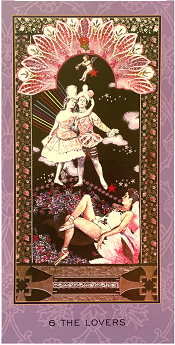
Intuition is an irrational function that perceives what things can become and synthesizes disparate elements into a meaningful whole. With it, archetypal images come alive. How do we develop this elusive, mysterious function? In this seminar, participants will work intuitively with the Tarot deck, exploring meaning in these centuries-old images, which, according to Jung, express archetypes of transformation.
For those who have studied Tarot previously, we will also deepen work with the multi-card spread, synthesizing individual cards in a spread into a coherent story.
N.B. Some Tarot decks will be provided for this seminar, and participants are also encouraged to bring decks of their own.
Seminar
Steven Minuk
In this seminar we will examine Jung’s notion of the archetypal nature of music and recent trends in psychotherapy that draw on this art form.
We will then discuss Jungian themes of opposition, persona, shadow and transformation in two videos by the Canadian musician: Hand in My Pocket and Thank U.
Participants must view the videos (linked above) before attending the seminar.
Seminars
Elisabeth Pomès
Sat. Dec. 2,
Sat. Dec 9
Individuation is the process of becoming whole, of being the person we are meant to be. It is a process rather than a final product, a journey of self-discovery rather than a final destination, and it always involves transformation. There is no Individuation without relatedness, whether it is to others or to oneself. Among the qualities essential for the process of Individuation are love, the opening of oneself to others and to the world in general, the courage to face fear with honesty and take risks, a generosity of the heart and the presence of Eros. These are the qualities which allow one to travel from pain to healing, from being a stranger to oneself to finding truly who we are.
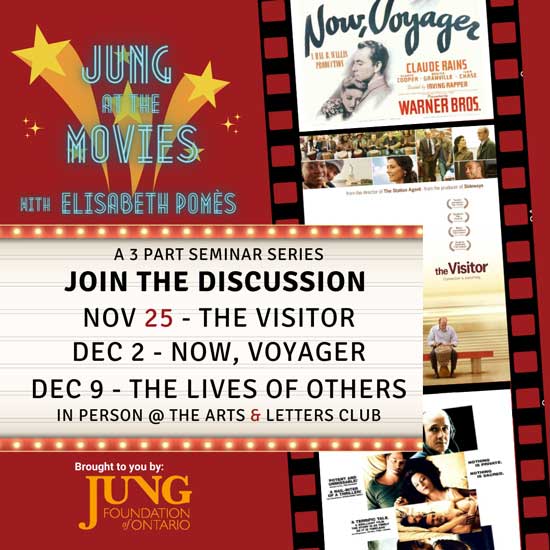
I invite you to join me in a discussion of the following movies:
Session 3A - Saturday, November 25th. 10am to 12:30pm. The Visitor
(T. McCarthy, 2007)
Walter Vale is a widowed college economics professor who lives a fairly solitary existence. His life will change when a chance encounter with an immigrant couple forces him to face issues relating to identity, connectedness, immigration and cross-cultural communication. The story of a transformation from being a visitor to his own life to truly embracing life in all its joys and sorrows.
Session 3B - Saturday, December 2nd. 10am to 12:30pm. Now, Voyager
(I. Rapper, 1942)
The title of this movie is borrowed from a poem by Walt Whitman “The Untold Want”:
The untold want by life and land ne'er granted,
Now, voyager, sail thou forth, to seek and find.
It is indeed the voyage that Charlotte Vale, a drab, quiet woman who is brutally dominated by her mother, must take. It is a voyage from rejection to love, from fear to the courage to face an abusive parent and from pain to healing.
Session 3C - Saturday, December 9th. 10am to 12:30pm. The Lives of Others
(F. H. von Donnersmarck, 2006)
He sits like a man taking a hearing test, big headphones clamped over his ears, his body and face frozen, listening for a faraway sound. His name is Gerd Wiesler, and he is a captain in the Stasi, the notorious secret police of East Germany. The year is, appropriately, 1984, and he is Big Brother, watching. He sits in an attic day after day, night after night, spying on the people in the flat below. The flat is occupied by a playwright and his mistress, an actress. Wiesler has been trained by his life to reflect no emotion. Sometimes not even his eyes move; he is like a cat awaiting a mouse. And he begins to internalize their lives -- easy, because he has no life of his own, no lover, no hobby, no distraction from his single-minded job. Then, something happens that will change his life forever.
Participants will be expected to have viewed the movies before the sessions. They are available on the usual streaming websites, Apple, Prime, Max, Roku, & Spectrum, as well as a few limited copies at the Toronto Public Library. Segments for discussion in each movie will be shown and discussed in the seminars.
Lecture
Dr. Samuel Kimbles
Shadows and Intergenerational Dynamics through Cultural Complexes
and Phantom Narratives
“What if your worst fears are the story of our times”?
Lowinsky
During these times of social and political upheavals the cultural unconscious is bursting through its expressions with enactments of chronic historic racial injustices, political polarizations, the global pandemic, global warming, social media and a multitude of other national and international political and cultural problems (which I called Cultural Complexes). These processes carry the Phantom Narratives of our collective legacies, ghosts, histories and their intergenerational traumas. How can the understandings we gleamed gleaned from these processes help us to both see and to deal with the extreme collective emotional states expressed and confront us in plain sight? How are we implicated in what we feel and see? What are their clinical implications?
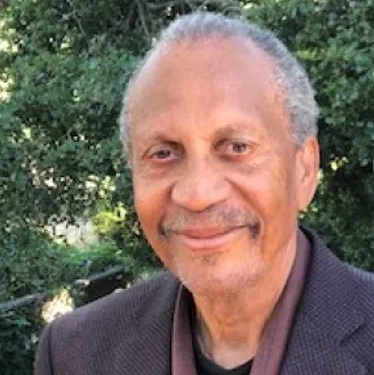 Samuel Kimbles, PhD is a clinical psychologist, training analyst, and member of the faculty of the C. G. Jung Institute of San Francisco, and a clinical professor (VCF) in the Department of Family and Community Medicine, University of California, San Francisco. Between September 1, 2008 and August 31, 2010 he served as president of the C. G. Jung Institute, San Francisco. He has lectured and presented papers on topics related to the theory and practical applications of analytical psychology to professional and lay audiences throughout the United States, Africa, and Europe. He is a clinical consultant and has taught at the San Francisco Jung Institute, colleges, and universities. In addition, he has trained mental health and analytic professionals on working with the unconscious life of groups. His published work on the cultural complex is a significant contribution of the application of analytical psychology to the study of groups and society. His previous book on cultural complexes was with Tom Singer, The Cultural Complex: Contemporary Jungian Perspectives on Psyche and Society (Routledge, 2004). He is author of Phantom Narratives: The Unseen Contributions of Culture to Psyche.
MEMBERS/students: $15 IN ADVANCE. NON MEMBERS: $20 IN ADVANCE
Back to top
2024
Lecture
Dr. E Maram
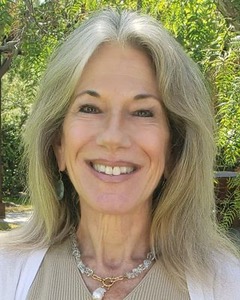 Jungian analyst Eve Maram’s The Schizophrenia Complex focuses on the thoughts and feelings
constellated by encounters with what we call schizophrenia, for those who experience symptoms, and for those others impacted by them. To do so, Dr. Maram had to face her own fear, denial, resistance, and ultimate not knowing. The events inspiring her were beyond her control and rearranged her life without her permission.
Jungian analyst Eve Maram’s The Schizophrenia Complex focuses on the thoughts and feelings
constellated by encounters with what we call schizophrenia, for those who experience symptoms, and for those others impacted by them. To do so, Dr. Maram had to face her own fear, denial, resistance, and ultimate not knowing. The events inspiring her were beyond her control and rearranged her life without her permission.
The unique complex she identifies results from our relationship with the unconscious, and our
corresponding personal and collective attitudes toward schizophrenia—how its meaning
manifests and the intense emotional responses it arouses. Dr. Maram also addresses how our
reactions to schizophrenia affect those we label as suffering it, potentially arousing their own complexes about their state. And she addresses how encounters with schizophrenia inevitably raise the question of how we relate to our own schizophrenic propensities—or at least our dreaded potential thereof—which in itself can become a complex.
Bridging from personal story to the collective and archetypal, here is a ground-breaking account
of the feelings and emotions generated by what we call schizophrenia. Also, here is a story
about the quintessential power of Eros to constellate hope, even when we are faced with the
chaos of the unconscious.
Eve Maram is a clinical and forensic psychologist and a certified Jungian Analyst in private
practice in Orange, California. She is a member of the Inter-Regional Society of Jungian Analysts
(IRSJA) and the CG Jung Institute of Santa Fe, as well as the International Association for
Analytical Psychology (IAAP). She has authored two books (Psychopathy Within, Chiron 2016
and The Schizophrenia Complex, Chiron 2022) as well as several chapters and articles.
MEMBERS/students: $15 IN ADVANCE. NON MEMBERS: $20 IN ADVANCE
Seminar
Robert Gardner
.png) The Return is a Russian film about two boys who have only known the world of the mothers, having been raised exclusively by their loving and protective mother and grandmother. Their life takes a different course when the father they have never known unexpectedly resurfaces after a twelve-year absence and takes them on a fishing trip into the Russian wilderness. What is it that has driven the father to take his sons on such a venture? And why did he return?
The Return is a Russian film about two boys who have only known the world of the mothers, having been raised exclusively by their loving and protective mother and grandmother. Their life takes a different course when the father they have never known unexpectedly resurfaces after a twelve-year absence and takes them on a fishing trip into the Russian wilderness. What is it that has driven the father to take his sons on such a venture? And why did he return?
The Director, Andrei Zvyagintsev, has said of his film “...if it wasn’t steeped in religious and mythological references, it wouldn’t have depth.” What are these references, and what is the archetypal drama he has tapped into? He has also offered that it “is about the metaphysical incarnation of the soul’s movement from the mother to the father.”
Participants must have viewed the movie prior to the seminar. It is available on YouTube & Google Play for a small fee. Limit of 15 participants.
IN ADVANCE by credit card/PayPal, or iN CASH AT THE DOOR
Seminars
Mar. 9, Apr. 6, Jun. 1
1:30-4pm (March and April)
10am-12pm (June)
In our continuing series on the fundamentals of analytical psychology, OAJA analysts will review Jung’s revolutionary views of psychic functioning in the following areas of interest:
1. Complexes: Do You Have Them Or Do They Have You? Sat. Mar. 9 1:30-4pm Steven Minuk
2. Exploring Jung’s concept of the Big Dream. Sat. Apr. 6 1:30-4pm Brenda Bunting*
3. Individuation and the Self Sat. Jun. 1 10am-12pm Dan Hansen. Please review this important information in advance of Mr. Hansen's seminar.
*The April seminar will be held in the Board Room, Arts and Letters Club, 14 Elm St. March and June seminars will be online via Zoom.
MEMBERS/students: $20. NON MEMBERS: $25
IN ADVANCE by credit card/PayPal, or for april 6 session, iN CASH AT THE DOOR
Lecture
Beaty Popescu
In this lecture I will discuss how through using what I call ‘Visual Active Imagination’ it is possible to give form and thus greater consciousness to unconscious material that graces or assails us at the very edge of our awareness. I will clarify how the non-verbal language of visual creativity can transport that which is still more or less of the unconscious, toward the light of consciousness. This visual transmutation is an expressive process, which pre-figures linear language. The above topic is both very close to my heart and deeply studied, as my first love and career in life has been as an artist and professor of visual art, and now my second passion and life’s path is working with psyche and practicing as a depth psychologist.
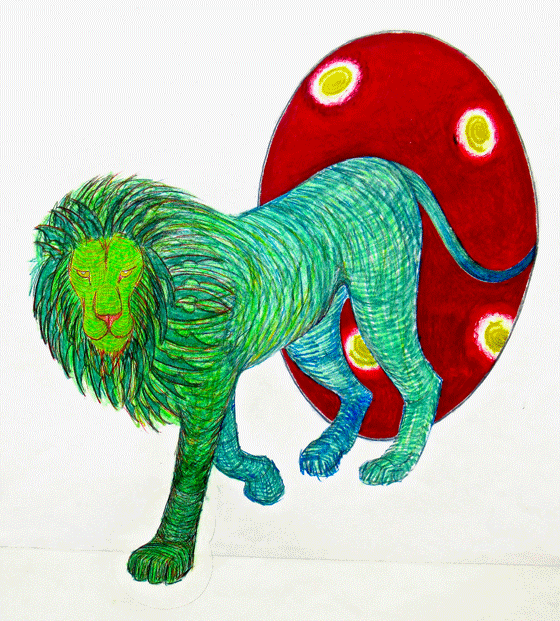
Beaty Popescu, who is a Jungian psychoanalyst, and practicing artist, studied visual art, gaining her Bachelor of Fine Art from York University in 1981, her Master of Fine Art from the Nova Scotia College of Art and Design University in 1985 and her Bachelor of Education with a visual art specialty from the University of Toronto in 1988. She went on to teach drawing, 3 dimensional design and sculpture at Memorial University of Newfoundland. Along side her University teaching, Beaty had an extensive national and smaller international exhibition career.
Parallel to Popescu’s commitment and calling to be a visual artist, she was deeply interested in the psychoanalytical understanding of the human psyche. She was no stranger to psychoanalysis having grown up with a beloved grandmother who was a practicing Freudian psychoanalyst, and having herself undergone both Freudian and Jungian analysis. Then in 1998, while on sabbatical, Beaty partook in the Jungian summer intensive course offered by the C.G. Jung Institute in Zurich, Switzerland. This experience clarified for her that she was deeply called to become a Jungian Psychoanalyst. By 2000 Popescu was able to fully let go of her tenure track university teaching career and deepen into a 5 year Jungian psychoanalytical study and training in Zurich, Switzerland.
Beaty has been practicing as a Jungian psychoanalyst since 2004, first in Ottawa, Ontario and now in Halifax, Nova Scotia. She continues to have a vibrant visual art practice, in which she gives form to uprisings from the realms of the unconscious
MEMBERS/students: $15. NON MEMBERS: $20
IN ADVANCE by credit card/PayPal
Workshop
Elisabeth Pomès and David Pressault
The workshop in two parts over Saturday and Sunday will propose an immersive exploration into one’s own shadow world through self reflection, journaling and inquiry.
 In the first workshop we will look briefly at Jung’s theory and then turn the light to ourselves. We will question our personal conscious point of view as well as our persona, family values and the way in which we have unconsciously adapted. We will consider what is disliked, detested, even hated: what we do not allow in ourselves and not permit in others.
The second part of the workshop will focus on shadow dreams (recognition and analysis of some themes) along with a focus on developing a more propitious attitude to the shadow and ask an essential question: is it possible to integrate our shadow?
In each workshop participants will do imaginative and embodied explorations to give voice to shadow material that might be coming up.
Needed material: A journal
IN ADVANCE by credit card/PayPal, or iN CASH AT THE DOOR
Seminar
Steven Minuk
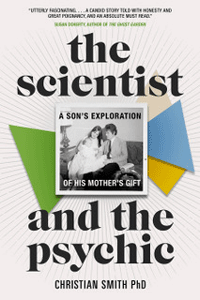
This seminar will be a discussion with Christian Smith, who recently published his book The Scientist and the Psychic (Random House Canada).
We will explore his experiences growing up as a child of a famous psychic, Geraldine (Smith) Stringer in the 1970s and 1980s. His decision to become a scientist and write critically about parapsychological phenomena will also be the focus of our discussion in the context of Jung’s writings on this subject.